Independent guide · checked 29 September 2026
Free loft insulation and loft insulation grants: who actually qualifies in 2026
This guide is for homeowners and private tenants who have seen "free loft insulation" offers and want to know whether any of it applies to them. Some households get their loft insulated for nothing. Many will not qualify. Here are the gates, the schemes that are still open, and what it costs if you pay yourself.
Figures from GOV.UK, Ofgem and the Energy Saving Trust, linked where they appear. We are not the government, an energy supplier or an installer.
Why the loft comes first
A bare loft is the cheapest heat leak in the house to fix
Quick answer: free loft insulation exists, but only through means-tested schemes. In Great Britain that is mainly ECO4 until 31 December 2026; in England the Warm Homes: Local Grant also pays for it through taking-part councils. If you qualify, the scheme pays for insulation to about 270mm. If you do not, a bare semi-detached loft costs about £750 to insulate and saves about £190 a year.
The Energy Saving Trust estimates that an uninsulated home loses around 25% of its heat through the roof. Warm air rises, the loft sits directly above the rooms you pay to heat, and without a thick layer on the loft floor that heat passes straight into a space nobody uses. That is why every funded scheme treats the loft as the first job, and why the energy company schemes insist on roof and wall insulation before they will fund a new heating system in a poorly rated home.
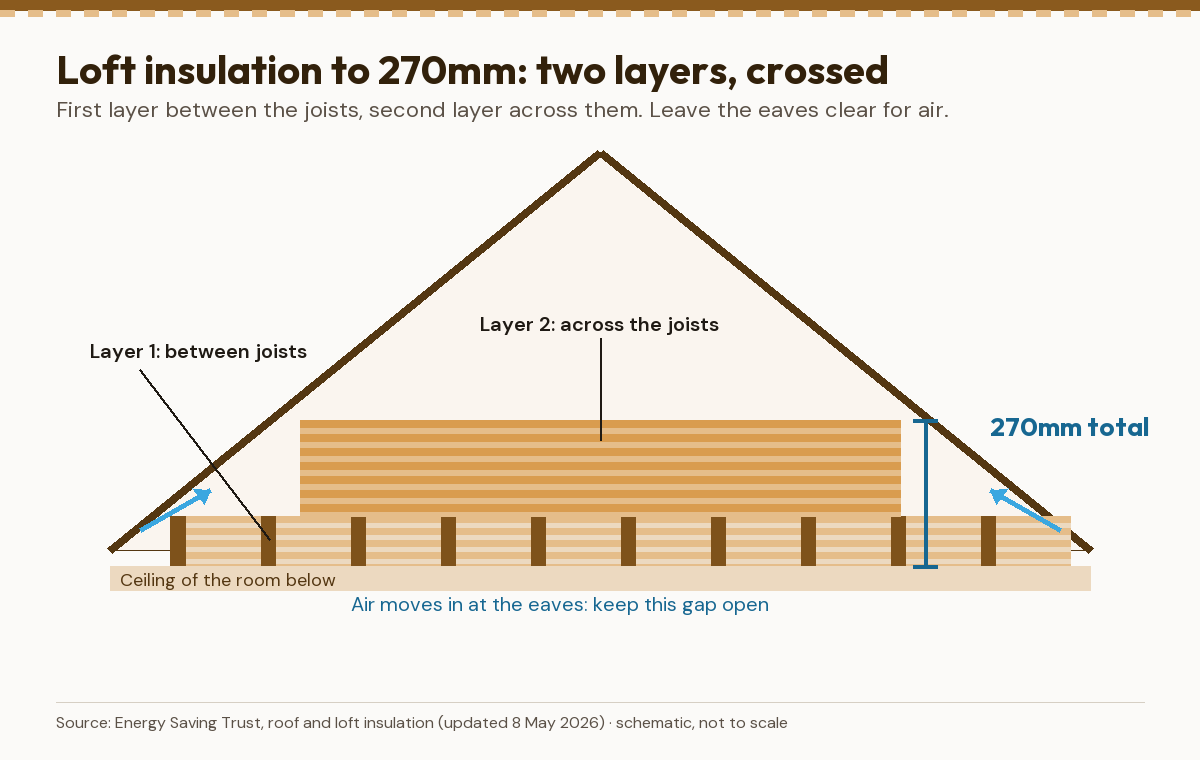
The number to remember is 270mm. Current building regulations recommend a minimum depth of 270mm for mineral wool insulation. It goes down in two layers: one laid between the wooden joists that form the loft floor, and a second laid across them at right angles so the joists stop acting as cold bridges. Installed properly, it lasts around 40 years, which is why the payback on a bare loft looks so good. See why 270mm is the figure and how to measure what you already have.
What matters for money is what is up there now. A loft with nothing, or a thin layer of 100mm or less, gains the most, and schemes record it as a separate, bigger measure. A loft that already has a decent layer gains far less from a top-up. Before you chase a grant, go up the ladder with a ruler.
Check before you give anyone your details
Which free route fits your home?
Answer five questions and see which schemes your answers point to, or whether you are realistically paying yourself. It runs in your browser: nothing is sent anywhere.
The checker applies the published rules: the benefit list on GOV.UK's ECO page, Ofgem's LA Flex income cap, the EPC bands each scheme accepts, the England-only Warm Homes: Local Grant, and the separate schemes in Scotland, Wales and Northern Ireland. It cannot see your council's own rules or whether a supplier still has capacity in the last months of ECO4, so treat a "yes" as a reason to apply, not a promise.
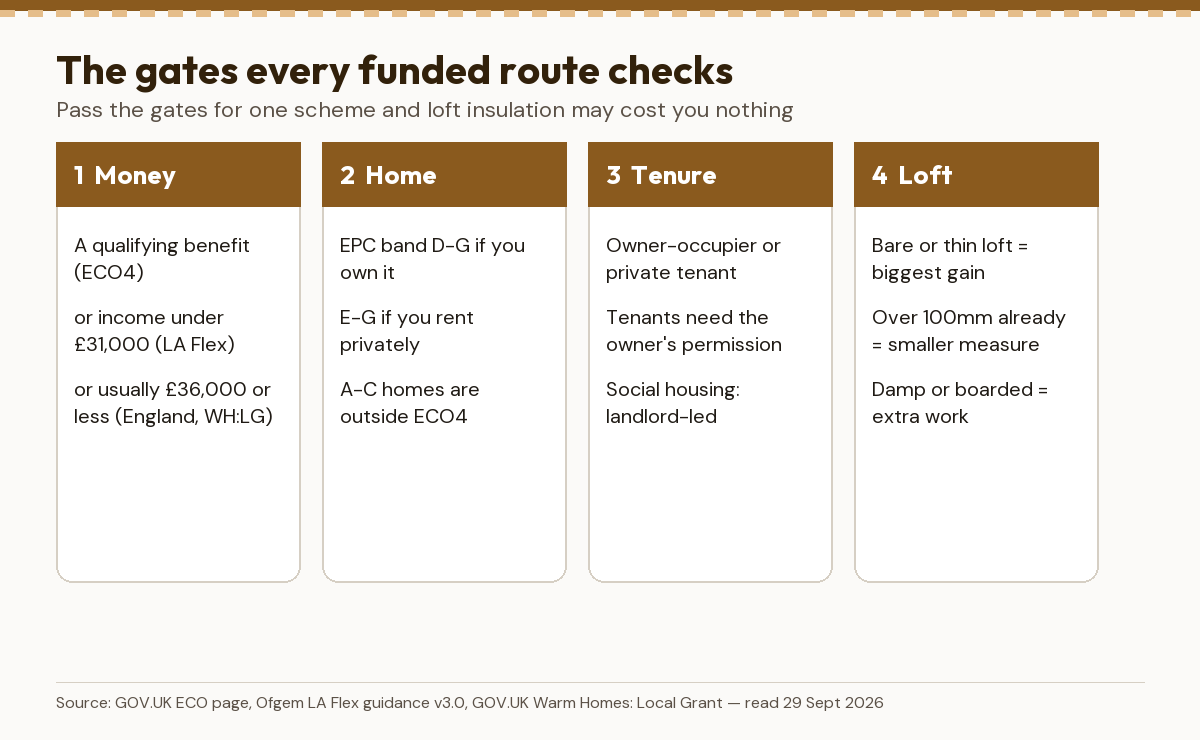
Want the long version? Who qualifies for free loft insulation walks through each gate with examples, and LA Flex covers the council route for households not on benefits.
One-minute route check
Five questions, no contact details. The result shows the routes your answers point to; the scheme, council or supplier makes the real decision.
Your indicative result
Indicative only, based on the published rules we read on 29 September 2026. Nothing is sent anywhere. Check your EPC band on the GOV.UK register before you apply.
Route comparison
Which scheme funds loft insulation now
Loft insulation is funded through different doors in each nation, and one of the best-known doors closed in March. This is the picture as we read it on 29 September 2026.
ECO4 benefits route
England, Scotland, Wales. A qualifying benefit such as Universal Credit, Pension Credit, Child Benefit or Housing Benefit, plus EPC D–G if you own (E–G if you rent privately).
Until 31 December 2026ECO4 LA Flex
Your council refers you: household income under £31,000, or proxy and medical routes. Same EPC and tenure rules.
Installs by 31 December 2026Warm Homes: Local Grant
England only, through councils taking part. Income usually £36,000 or less, certain postcodes or benefits; EPC D–G; privately owned homes.
To 31 March 2028Scotland
Warmer Homes Scotland for passport benefits, over-75s without heating or medical certificates; the HES Grant and Loan offers a loft grant up to £1,500 with no benefit test.
OpenWales
Nest: free improvements for owners and private tenants on a means-tested benefit or low income, in homes rated EPC E or lower (D with an eligible health condition).
OpenNorthern Ireland
Affordable Warmth: gross household income under £23,000, owners and private renters, loft insulated or topped up to 300mm. NISEP grants too.
OpenGreat British Insulation Scheme
The non-means-tested route by council tax band. It has ended and is not coming back in its old form.
Closed 31 March 2026Full detail, including what replaces ECO4 after December, is on government loft insulation schemes compared. Nation pages: Scotland, Wales, Northern Ireland.
What a loft is worth
The numbers, from the Energy Saving Trust
The Energy Saving Trust updated its loft figures in May 2026, using July 2026 fuel prices for Great Britain. They assume a gas-heated home and unsubsidised professional installation. Many sites still quote an older headline saving of £590 a year. The current figures are lower, and they vary a lot by house type:
| Home | Cost, 0 to 270mm | Saving a year | Top-up saving (120 to 270mm) |
|---|---|---|---|
| Detached house | £1,100 | £360 | £35 |
| Semi-detached house | £750 | £190 | £17 |
| Mid-terrace house | £650 | £140 | £13 |
| Detached bungalow | £1,200 | £350 | £35 |
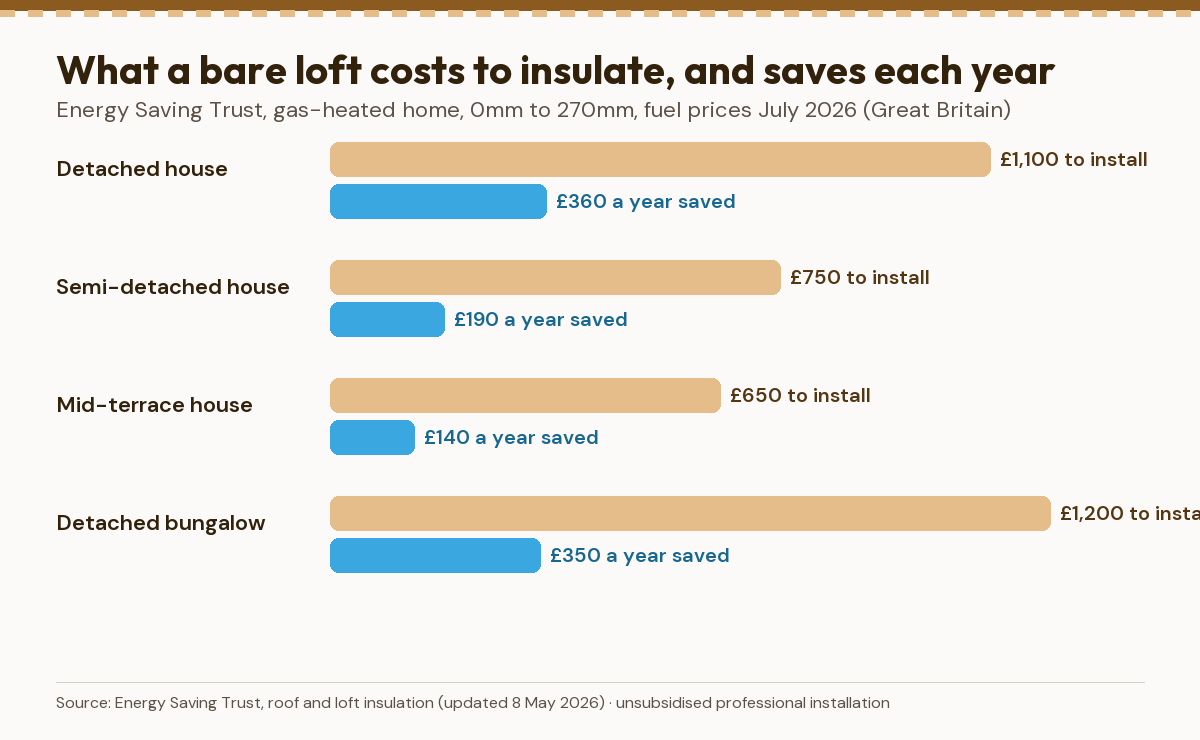
Think of it as a one-off purchase that pays you back. On the EST figures a bare semi-detached loft costs about £750 and returns about £190 a year, so it has paid for itself in roughly four years and keeps saving for decades after. Every winter without it, that money leaves through the roof and buys you nothing.
If no free route fits, you still have options. A professional job carries 0% VAT until 31 March 2027 (then 5%). In Scotland, homeowners can apply for a Home Energy Scotland loft grant of up to £1,500, with interest-free loans for other measures. A dry, easy-to-reach loft can be done yourself for the cost of materials, which are standard-rated for VAT. See the cost guide and estimator and the DIY route.
Two neighbours, one terrace of semis
Why one household pays nothing and the next pays about £750
Not real households. The figures are the Energy Saving Trust's published averages for a semi-detached house, and the rules are the ones on this page.
Number 12 is owned by a couple on Universal Credit. Their EPC says band E and the loft has a thin, patchy layer. They pass every ECO4 gate: a qualifying benefit, an owner-occupied home rated D to G, and a loft with 100mm or less. A supplier or its installer can fund the loft, usually as part of a wider package, and they sign a pre-existing loft declaration before any work starts. Their likely cost for the loft is nothing, although Ofgem notes that some households are asked to contribute.
Number 14 is identical, but the owners earn more than £36,000 between them and claim no benefits. They are above the LA Flex cap and the usual Warm Homes: Local Grant income line. No free route fits unless a council proxy or medical route applies. Paying a contractor, the EST puts the job at about £750 with a saving of about £190 a year. If number 14 already had 120mm up there, the sums change completely: a top-up adds an extra £17 or so a year, and the honest advice is that it is a comfort upgrade rather than a money-maker.
The same house, the same street, two different answers. That is why we start with the gates, not with a promise. Is loft insulation worth it? runs the payback for every house type.
How a funded loft job runs
From enquiry to insulated loft
- Check your EPC band on the GOV.UK register. No certificate or an old one? The assessor will produce a new rating as part of the process.
- Choose your door. A supplier or installer delivering ECO4, your council for LA Flex or the Warm Homes: Local Grant, or your nation's scheme in Scotland, Wales or Northern Ireland.
- Assessment. A retrofit assessment checks the home, the loft and ventilation, and the scheme decides which measures it will fund.
- Loft declaration. Under ECO4 you and the installer sign a declaration of what insulation is already there, and a copy is left by the loft hatch.
- Installation and guarantee. Mineral wool to about 270mm, eaves kept clear, and paperwork you keep: the installer's details and the guarantee.
The honest worry is not the price. It is who is in your loft. Funded work should be done by a business registered with TrustMark, working to PAS 2035. Check the register yourself before anyone starts. GOV.UK's advice on cold callers is simple: if you are not sure an offer is genuine, contact your local council or the energy supplier the caller says they represent. You are under no obligation to accept any quote, and there is no reason to pay anything on the doorstep: take the time to check.
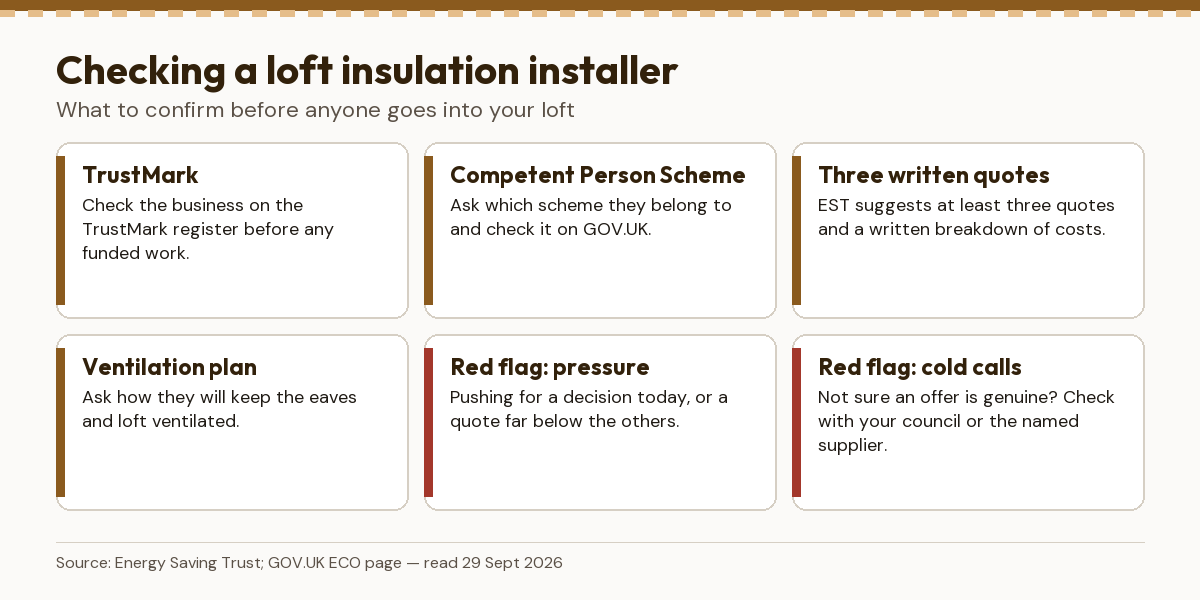
More on choosing a loft insulation installer and on spotting a scam.
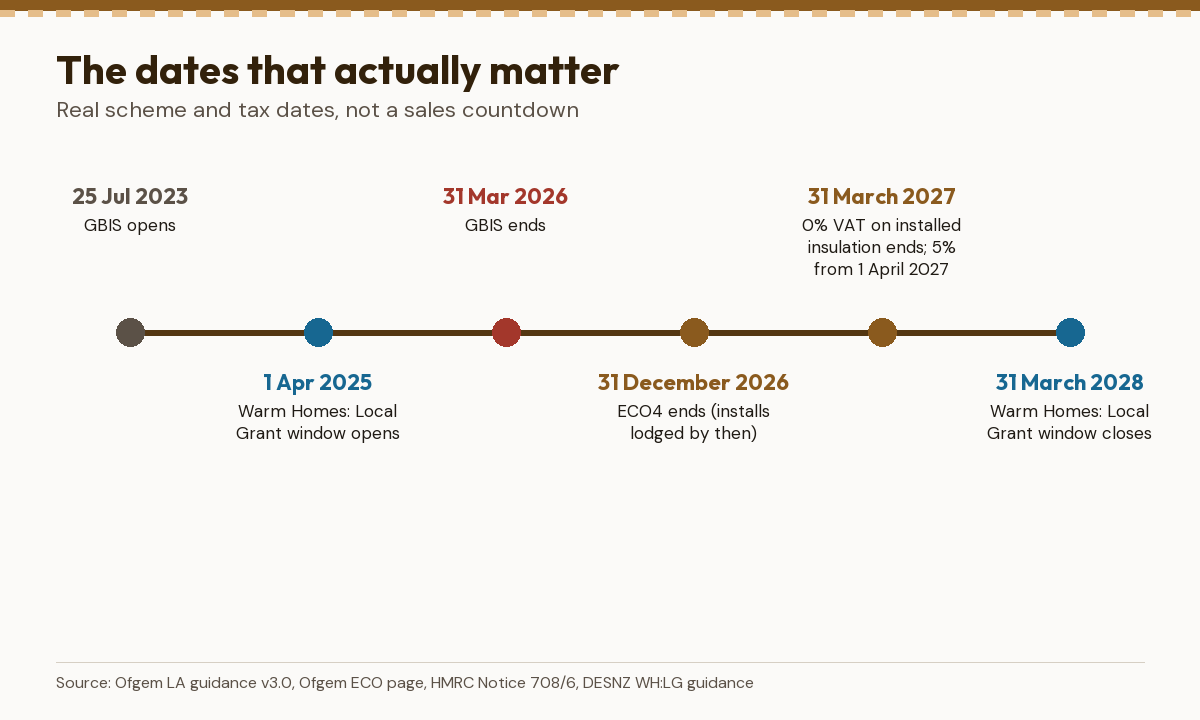
The real dates
Three dates worth knowing, and no countdown clock
We do not run deadline gimmicks, and nothing on this site expires at midnight. These three dates come from Ofgem, HMRC and the Department for Energy Security and Net Zero, and each one changes what you can get.
- ECO4 ends. Ofgem requires suppliers to finish their obligations by this date, so work has to be installed and lodged before it, not just applied for. Capacity in the final months is not guaranteed.
- The last day of 0% VAT on professionally installed insulation. From 1 April 2027 it reverts to 5%. This matters only if you are paying.
- The Warm Homes: Local Grant window closes in England. The Warm Homes Plan says it will be folded into a single low-income scheme from 2027/28.
What happens after ECO4? Read loft insulation after ECO4 ends.
Is there a catch?
The questions people are too polite to ask
If it is free, how does anyone make money?
Under ECO4 the big energy suppliers are legally obliged to fund efficiency work, and they pay installers to deliver it. Under the Warm Homes: Local Grant the government funds councils. Nobody is doing it out of kindness, which is exactly why you should check who you are dealing with. This site does not charge you for passing on an enquiry, and nothing about that changes what the scheme rules say.
Will they insist on other work I do not want?
ECO4 is a whole-house, fabric-first scheme, so loft insulation often comes as part of a package that has to improve the home's EPC band. You can say no to a package; you do not have to accept work to get an assessment.
Can it make my loft damp?
It can, if the job ignores ventilation. Insulation makes the loft space colder, so moist air can condense. Keep the eaves clear, fix any leaks first, and ask the installer how they will ventilate the space. See loft ventilation and condensation.
I use the loft for storage. Do I lose it?
No, but boards laid straight onto a full layer squash it. The Energy Saving Trust suggests raising the floor on supports, adding the second layer underneath and leaving a small air gap under the boards. See loft boarding and insulation.
Someone says my old insulation must be ripped out and replaced with spray foam.
The Energy Saving Trust records this as a sales line some installers have used. Mineral wool at joist level is one of the lowest-risk ways to insulate a loft; spraying foam under an old roof is one of the highest. Read spray foam insulation: problems and removal first.
Find your answer
Start from your situation
I am a pensioner
Pension Credit is a qualifying benefit; Scotland has an over-75 route.
I rent, or I am a landlord
EPC E to G and the owner's permission.
I want ECO4 before it ends
What is left before 31 December 2026.
I already have some insulation
Why a top-up saves £13 to £35 a year.
I will pay myself
EST prices and a payback estimator.
My loft is a room
Rafter-level insulation and room-in-roof.
My supplier offered it
How supplier-funded loft insulation works.
I have a quick question
Straight answers, sourced.
Free loft insulation: common questions
Can I really get free loft insulation in 2026?
Yes, if your household passes a scheme's gates. In Great Britain the main route is ECO4, which runs until 31 December 2026 and needs a qualifying benefit or a council LA Flex referral (for example household income under £31,000), plus an EPC band of D to G if you own the home (E to G if you rent privately). In England the Warm Homes: Local Grant also funds loft insulation through taking-part councils. If you miss the gates, you pay.
Is the Great British Insulation Scheme still running?
No. The Great British Insulation Scheme ended on 31 March 2026; GOV.UK's eligibility service has closed. Pages still inviting you to "apply for GBIS" are out of date.
Can I get free loft insulation if I am not on benefits?
Possibly. ECO4 LA Flex lets a council refer households with a combined gross income under £31,000, or through proxy and medical routes. In England the Warm Homes: Local Grant usually accepts incomes of £36,000 or less. In Scotland the Home Energy Scotland Grant and Loan offers a loft insulation grant of up to £1,500 without any benefit test.
How thick should loft insulation be?
The Energy Saving Trust says current building regulations recommend a minimum of 270mm for mineral wool, usually laid as two layers: one between the joists and one across them.
How much does loft insulation cost if I pay myself?
Energy Saving Trust figures for a bare loft insulated to 270mm: about £650 for a mid-terrace, £750 for a semi, £1,100 for a detached house and £1,200 for a detached bungalow (Great Britain, unsubsidised). Installed insulation carries 0% VAT until 31 March 2027.
Does British Gas or another supplier give free loft insulation?
Large energy suppliers fund ECO4 measures because the law obliges them to, until 31 December 2026. Ofgem says you can contact any obligated supplier, even if it is not yours, and that in some cases you may be asked to contribute.
I already have some loft insulation. Is a top-up free?
Sometimes, but the gain is small. The Energy Saving Trust puts the saving from topping up 120mm to 270mm at an extra £17 or so a year for a semi-detached house, against £190 for insulating a bare loft. Schemes treat thin lofts (100mm or less) and thicker ones as different measures.
Who is this site?
An independent guide published by SEO-DONS LTD. We are not the government, an energy supplier or an installer. If you ask for quotes, we pass your enquiry to independent firms covering your postcode, and they contact you directly.
Ask for loft insulation quotes or a second opinion
Tell us a little about your situation. We pass your enquiry to relevant independent firms covering your postcode; they contact you directly. There is no charge to you for this.
What happens next
- We read your enquiry and check which kind of firm can help.
- We pass it to relevant independent firms that cover your postcode.
- They contact you with questions or a quote. You compare, and decide — with no obligation to go ahead.